
A single batch of compromised lubricant can jeopardize a multi-million dollar maritime asset, yet procurement strategies often fail to reflect the critical nature of this essential engineering component. You recognize that maintaining operational continuity while adhering to the 2026 EU ETS maritime expansion and new SOLAS safety requirements is an increasingly complex administrative and technical challenge. Selecting a premier marine gear oil supplier isn’t merely a logistical task; it’s a strategic decision that directly impacts your fleet’s longevity and international regulatory standing. This article provides a comprehensive framework for identifying a partner who can deliver the chemical precision and batch consistency your vessels demand for peak performance.
We’ll examine the critical technical benchmarks for demulsification that prevent equipment downtime, the latest regulatory mandates effective as of January 2026, and the essential criteria for establishing a resilient, high-volume supply chain. By prioritizing precision blending technology and integrated production capabilities, fleet managers can secure a stable foundation for national operations while successfully meeting global maritime standards. Discover how the right lubrication partner transforms maintenance from a reactive expense into a proactive asset management strategy that ensures long-term machinery health.
Key Takeaways
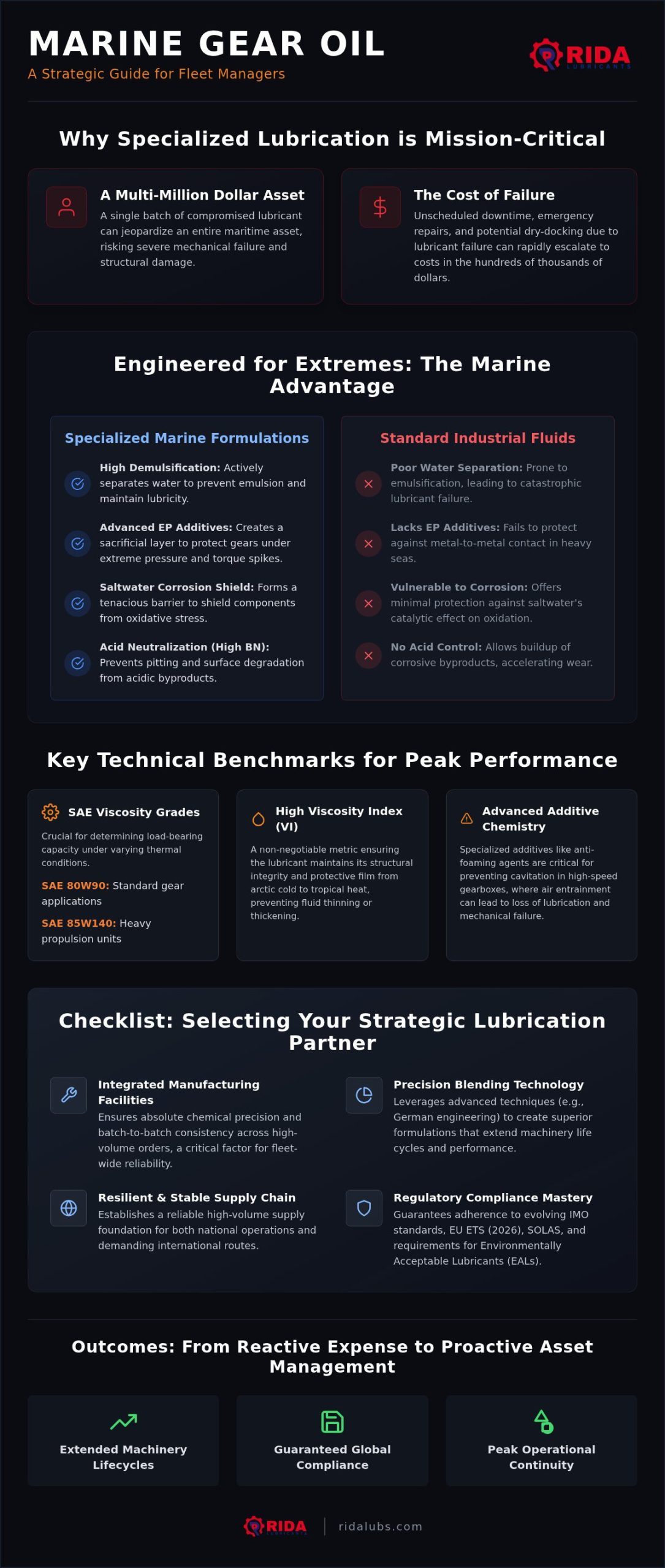
- Distinguish between standard industrial fluids and specialized marine formulations by analyzing the chemical requirements for extreme pressure and high-moisture environments.
- Establish a strategic B2B framework for evaluating a marine gear oil supplier, focusing on integrated manufacturing facilities that guarantee consistency across high-volume orders.
- Ensure your fleet remains compliant with evolving International Maritime Organization (IMO) standards and the specialized requirements for Environmentally Acceptable Lubricants (EALs).
- Analyze the technical importance of viscosity grades and additive chemistry in maintaining equipment stability through the diverse temperature fluctuations encountered at sea.
- Discover how leveraging precision German blending technology and a stable national supply chain can significantly extend the operational life cycles of critical maritime machinery.
The Critical Role of Specialized Marine Gear Oil in Vessel Maintenance
Maritime operations demand a level of mechanical resilience that standard industrial lubricants simply can’t provide. Marine gear oil is a specialized, high-performance fluid specifically formulated to maintain its integrity within extreme pressure (EP) environments that are frequently subjected to high moisture levels. While industrial gear oils might suffice for static factory machinery, they often lack the sophisticated demulsification properties required to separate water from the oil effectively. For a fleet manager, selecting the right marine gear oil supplier is a critical step in ensuring that propulsion systems, bow thrusters, and steering gear assemblies remain protected against the relentless ingress of seawater.
The financial consequences of lubricant failure extend far beyond the cost of the oil itself. When a vessel experiences gear seizure or bearing failure due to emulsified fluid, the resulting unscheduled downtime and potential dry-docking costs can reach hundreds of thousands of dollars. It’s a risk that professional operators mitigate through rigorous fluid selection and a commitment to technical excellence in their supply chain.
Combating Saltwater Corrosion and Oxidation
Saltwater acts as a powerful catalyst for electrochemical reactions, particularly when metal surfaces are subjected to the high operational heat of a heavy-load gearbox. Premium marine lubricants are designed to form a tenacious protective barrier that shields internal components from oxidative stress. This protection is further enhanced by a sophisticated understanding of lubricant properties and additives, specifically the inclusion of high Base Number (BN) components. These additives are essential for the effective neutralization of acidic byproducts that form during the oxidation process, which prevents the localized pitting and surface degradation that leads to long-term structural failure.
Load-Bearing Capacity in Heavy Seas
Operating in heavy seas subjects a vessel’s drivetrain to erratic torque spikes and intense wave-induced vibrations that can easily compromise a standard lubricant film. Maintaining adequate film thickness is paramount to preventing metal-to-metal contact between gear teeth during these peak load periods. High-quality formulations utilize advanced Extreme Pressure (EP) additives that chemically bond with metal surfaces under stress, creating a sacrificial layer that absorbs energy. A reliable marine gear oil supplier ensures that these additives are precisely balanced to maintain film strength without causing excessive chemical wear on yellow metals, providing the stability needed for national and international operations.
Technical Specifications: Viscosity Grades and Additive Chemistry
Precision in lubricant selection starts with a rigorous understanding of SAE viscosity grades, as these classifications determine the fluid’s load-bearing capacity under varying thermal conditions. Most commercial vessels rely on SAE 80W90 for standard gear applications, while heavier propulsion units often require the robust film thickness provided by SAE 85W140. A high Viscosity Index (VI) is non-negotiable for maritime operations, ensuring that the lubricant maintains its structural integrity whether the vessel is navigating arctic waters or tropical trade routes. Partnering with a specialized marine gear oil supplier ensures that these grades are reinforced with advanced anti-foaming agents, which are essential for preventing cavitation in high-speed gearboxes where air entrainment can lead to mechanical failure.
While NMMA certification standards provide a baseline for recreational craft, commercial-grade gear oils must exceed these benchmarks through superior additive chemistry. High-speed gearboxes generate significant turbulence, making the integration of anti-foaming agents a critical requirement. These chemicals work by reducing the surface tension of air bubbles, causing them to collapse rapidly and maintaining a continuous liquid film between moving parts. Without this specific chemical intervention, air pockets can displace the oil, leading to localized overheating and rapid tooth wear.
Demulsification: The Secret to Marine Reliability
Water contamination remains the primary catalyst for premature gear failure at sea, as even minor ingress can transform a high-performance lubricant into a corrosive, ineffective emulsion. High-quality marine lubricants utilize sophisticated demulsifiers that facilitate the rapid separation of water from the oil, allowing for efficient drainage from sumps during routine maintenance. The efficacy of this process is often measured through standardized demulsibility tests, where a premium fluid must achieve complete separation within a specified timeframe to ensure the continued protection of internal components. Utilizing high-quality base oils significantly enhances this separation capability, as pure molecular structures don’t hold onto water molecules as aggressively as lower-grade alternatives.
Additive Packages and German Blending Precision
The synergy between sulfur-phosphorus extreme pressure additives and high-quality base stocks is what defines a truly elite marine lubricant. Utilizing German blending technology allows for a level of chemical precision that ensures every drop of fluid contains a uniform distribution of these critical components. This technical edge extends to the inclusion of friction modifiers, which reduce internal drag and can lead to measurable improvements in fuel economy. For those seeking to optimize their procurement strategy, exploring the technical advantages of precision-blended gear oils can provide the operational stability required for modern fleet management.
Evaluating a Marine Gear Oil Supplier: A Strategic B2B Framework
Procurement professionals must look beyond technical data sheets to scrutinize the operational infrastructure of a potential marine gear oil supplier. A strategic partnership in the maritime sector requires a supplier that maintains absolute control over the production lifecycle, from raw material sourcing to final chemical verification. Integrated manufacturing capabilities are essential for ensuring that every delivery meets rigorous specifications, as third-party blending often introduces variables that compromise fluid stability. By selecting a partner with a fully integrated facility, fleet operators secure the batch-to-batch consistency necessary for large-scale operations where standardized maintenance protocols are paramount. This stability is particularly vital when managing diverse fleets that operate across varying environmental conditions, as it guarantees that the lubricant’s performance remains predictable regardless of the delivery date.
Reliable technical support serves as a cornerstone of this B2B framework. A leading supplier doesn’t just deliver product; they provide sophisticated oil analysis services that enable predictive maintenance and extend machinery life cycles. These services allow engineers to monitor wear metals and additive depletion in real-time, preventing catastrophic failures before they occur. Additionally, the logistics of national distribution and lead-time reliability are non-negotiable factors. Vessel schedules depend on the timely arrival of critical lubricants, and any delay in the supply chain can lead to expensive port fees or missed charter windows. An authoritative partner understands these stakes and maintains the infrastructure necessary to support tight operational timelines.
Manufacturing Infrastructure and Quality Control
A fully integrated production facility significantly reduces supply chain risks by eliminating dependence on external blenders. When a facility, such as one founded on modern engineering principles in 2017, manages its own in-house laboratory, every batch undergoes rigorous testing to verify chemical balance before it leaves the plant. Adherence to international blending standards and recognized certifications provides a layer of corporate transparency that builds trust with industrial partners. This level of oversight ensures that the precision of the initial formulation is preserved throughout the high-volume manufacturing process, providing a dependable foundation for fleet-wide excellence.
B2B Supply Chain and Wholesale Capabilities
Assessing a supplier’s wholesale capacity involves evaluating their ability to handle high-volume bulk orders without sacrificing lead-time efficiency. Professional fleet management requires flexible packaging options, ranging from standard 208-liter drums to bulk tanker deliveries, to accommodate diverse vessel requirements. An international outlook, supported by global administrative offices like a New York head office, ensures that the supplier understands the complexities of cross-border maritime logistics. This stability is particularly valuable for national operations that require a dependable supply chain to maintain fleet excellence across multiple ports of call.
Regulatory Compliance: IMO 2020 and Environmental Standards
Regulatory adherence is a non-negotiable pillar of modern fleet excellence, requiring a level of transparency that only a sophisticated marine gear oil supplier can provide. As international maritime laws become increasingly stringent, the burden of proof for environmental compliance shifts toward the chemical composition of the lubricants themselves. Providing comprehensive Material Safety Data Sheets (MSDS) is the baseline for supplier accountability, ensuring that every additive is accounted for and verified against regional safety standards. This transparency is vital for vessels navigating a landscape where environmental footprints are scrutinized as heavily as mechanical performance. Compliance is the baseline for trust. It’s the only way to ensure long-term access to global trade routes.
Navigating the IMO 2020 Landscape
The global sulfur cap of 0.50% m/m, and the 0.10% m/m limit within Emission Control Areas (ECAs), continues to dictate the technical requirements for maritime fluids. While these regulations primarily target fuel, they necessitate specialized gear lubrication formulations that are chemically compatible with the low-sulfur environments and the exhaust gas cleaning systems often employed to meet these standards. Maintaining a relationship with a knowledgeable marine gear oil supplier allows fleet managers to navigate these complexities with confidence. Compliance is further complicated by the EU Emissions Trading System (EU ETS) maritime expansion, which, as of January 1, 2026, requires shipping companies to surrender allowances for 70% of their verified CO2 emissions from the previous year. Strategic lubricant standardization across a fleet ensures that vessels remain compliant with these evolving mandates while maintaining peak operational efficiency in every global port.
The Rise of Biodegradable Gear Oils
Demand for Environmentally Acceptable Lubricants (EALs) is accelerating as maritime zones in the Canadian Arctic and the Norwegian Sea implement stricter Nitrogen Oxide (NOx) and Sulfur Oxide (SOx) emission controls throughout 2026. To qualify as an EAL, a lubricant must demonstrate high biodegradability, low toxicity, and a lack of bioaccumulative potential. While mineral-based EALs offer a cost-effective entry point, synthetic alternatives provide significantly better oxidative stability and longer service intervals, reducing the frequency of oil changes and the risk of incidental discharge. This is particularly relevant as the industry prepares for the final enforcement of the Vessel Incidental Discharge Act (VIDA) standards by the U.S. Coast Guard, which is expected by October 2026. Synthetic options often prove more durable. They protect your assets and the environment simultaneously.
To ensure your fleet meets these rigorous international standards without compromising on equipment protection, explore the range of compliant gear oils engineered for the modern maritime sector.
Rida Lubricants: Engineering Excellence for the Global Marine Sector
Rida Lubricants stands as a definitive authority in the maritime lubrication sector, providing a level of technical precision that’s essential for high-load commercial applications. Since its foundation in 2017, the organization has focused on scaling its integrated production capabilities to meet the demanding requirements of national and international fleets. By positioning itself as a premier marine gear oil supplier, the company leverages advanced German blending technology to ensure that every additive package is perfectly balanced for extreme maritime conditions. This commitment to excellence is reflected in the brand’s ability to maintain high-volume supply chains while adhering to the most rigorous international standards. It’s a level of corporate stability that provides industrial partners with the confidence required to operate in volatile global markets.
The Rida Advantage: Technology and Scale
The core of the Rida advantage lies in a fully integrated facility where every gallon of gear oil is subjected to rigorous quality control protocols. By integrating every stage of the production process, the brand eliminates the uncertainties often associated with third-party chemical blending. German innovation is central to this process; it enables the creation of lubricants that exhibit exceptional resistance to high-heat oxidative stress. These formulations are specifically engineered to maintain their chemical stability even when subjected to the erratic torque and heavy loads common in propulsion systems. This methodical approach to manufacturing ensures that industrial partners receive a product that’s both reliable and technically superior to standard market offerings. Every batch is a testament to the brand’s dedication to precision engineering and durability.
Strategic Partnership for National Fleets
For national fleets, the stability of the supply chain is as critical as the quality of the lubricant itself. Rida Lubricants supports its regional expertise with a global outlook, coordinated through its New York head office to ensure seamless distribution across international ports. Bulk procurement through a trusted marine gear oil supplier allows fleet managers to reduce long-term operational costs by minimizing the risks associated with inconsistent batch quality and equipment downtime. The brand’s commitment to reliability and technical authority establishes it as a visionary partner for organizations that prioritize excellence in their maritime operations. It’s a relationship built on the foundation of permanence and regional expertise that modern shipping demands. To secure the future of your fleet’s machinery, Partner with Rida Lubricants for your marine gear oil needs.
Advancing Fleet Resilience Through Strategic Lubrication Partnerships
The transition toward a more efficient and compliant maritime future requires a shift from transactional procurement to strategic engineering partnerships. By prioritizing technical benchmarks such as rapid demulsification and high viscosity stability, fleet managers ensure that their vessels can withstand the unique chemical and physical stressors of global trade routes. Adhering to evolving environmental standards is no longer optional; it’s a foundational requirement for international port access. Selecting a premier marine gear oil supplier that provides batch-to-batch consistency and transparent safety data is the most effective way to safeguard your machinery’s long-term health and efficiency.
Rida Lubricants offers the stability and technical authority required for national and international operations. Our commitment to excellence is evidenced by our precision German blending technology and a fully integrated national production facility that guarantees superior quality control for every high-volume order. With an international distribution network supported by our New York head office, we provide the reliable supply chain your fleet needs to maintain operational excellence. It’s time to elevate your maintenance standards with a partner that values legacy and technical prowess in equal measure. We look forward to supporting your fleet’s journey toward peak performance.
Secure Your Bulk Marine Lubricant Supply with Rida Lubricants
Frequently Asked Questions
What is the difference between automotive and marine gear oil?
Marine gear oil is specifically engineered to handle constant moisture and potential saltwater contamination, whereas automotive gear oil lacks advanced demulsifiers. While automotive fluids focus on heat dissipation and friction reduction in dry environments, marine-grade lubricants must separate water rapidly to prevent the formation of corrosive emulsions. A specialized marine gear oil supplier ensures these formulations include high-performance additives that protect propulsion systems against the unique electrochemical stresses found at sea.
How often should marine gear oil be analyzed for water content?
Most fleet operators should conduct oil analysis for water content every three months or every 2,500 operational hours to ensure machinery health. In critical systems like bow thrusters or main propulsion gearboxes, monthly testing is often preferred to detect seal failures early. Regular monitoring allows engineers to identify moisture ingress before it causes irreversible oxidative damage or metal-to-metal contact, which significantly reduces the risk of expensive unscheduled dry-docking.
Can I mix different brands of marine gear oil in one system?
Mixing different brands of gear oil is generally discouraged because additive packages from different manufacturers can be chemically incompatible. When conflicting sulfur-phosphorus additives or friction modifiers interact, they might precipitate out of the fluid, creating sludge that blocks filters and reduces lubrication efficiency. It’s best to perform a full system flush when switching to a new marine gear oil supplier to maintain the chemical integrity and performance of the lubricant.
What are the signs of gear oil degradation in a marine propulsion system?
The most common indicator of degradation is a milky or cloudy appearance, which signals significant water emulsification within the system. Other warning signs include a strong, burnt odor indicating thermal oxidation or an increase in localized vibration and noise from the gearbox. If a visual inspection reveals dark, thickened fluid or visible metal particulates in the filters, the oil has lost its load-bearing capacity and requires immediate replacement to prevent gear failure.
How does German blending technology improve marine lubricant performance?
German blending technology utilizes automated, high-precision systems to ensure the exact chemical balance of complex additive packages in every batch. This methodical approach eliminates the human error often found in manual blending, resulting in a lubricant that performs predictably under extreme pressure and high-heat conditions. For fleet managers, this precision translates into more durable machinery and more consistent performance across high-volume B2B orders, ensuring that every gallon of fluid meets international maritime standards.
What are Environmentally Acceptable Lubricants (EALs) and are they required?
Environmentally Acceptable Lubricants (EALs) are biodegradable, non-toxic fluids required for all oil-to-sea interfaces on commercial vessels. These regulations are enforced by the US EPA’s Vessel General Permit and the upcoming 2026 VIDA standards. While they’re mandatory in US waters and certain European environmentally sensitive areas, many global operators are adopting them fleet-wide to simplify compliance and demonstrate a commitment to reducing their environmental footprint in sensitive marine ecosystems.
What viscosity grade is best for heavy-duty marine steering gear?
Heavy-duty marine steering gear typically requires high-viscosity lubricants, such as SAE 90 or SAE 140, which correspond to ISO VG 150 through 320. These thicker fluids are necessary to maintain a robust protective film under the slow-speed, high-torque conditions common in steering actuators. You should always consult the original equipment manufacturer’s specifications, as using an incorrect viscosity grade can lead to sluggish response times or accelerated wear on hydraulic components and gear teeth.
How does a supplier ensure batch consistency for large-scale B2B orders?
A supplier ensures batch consistency by operating a fully integrated production facility where every stage of manufacturing is monitored in an in-house laboratory. Rida Lubricants, for instance, utilizes infrastructure founded in 2017 to maintain absolute control over raw materials and blending ratios. This level of oversight prevents the variations common in third-party manufacturing, providing national and international partners with the stable, high-quality supply chain necessary for maintaining fleet-wide excellence and predictable maintenance schedules.