
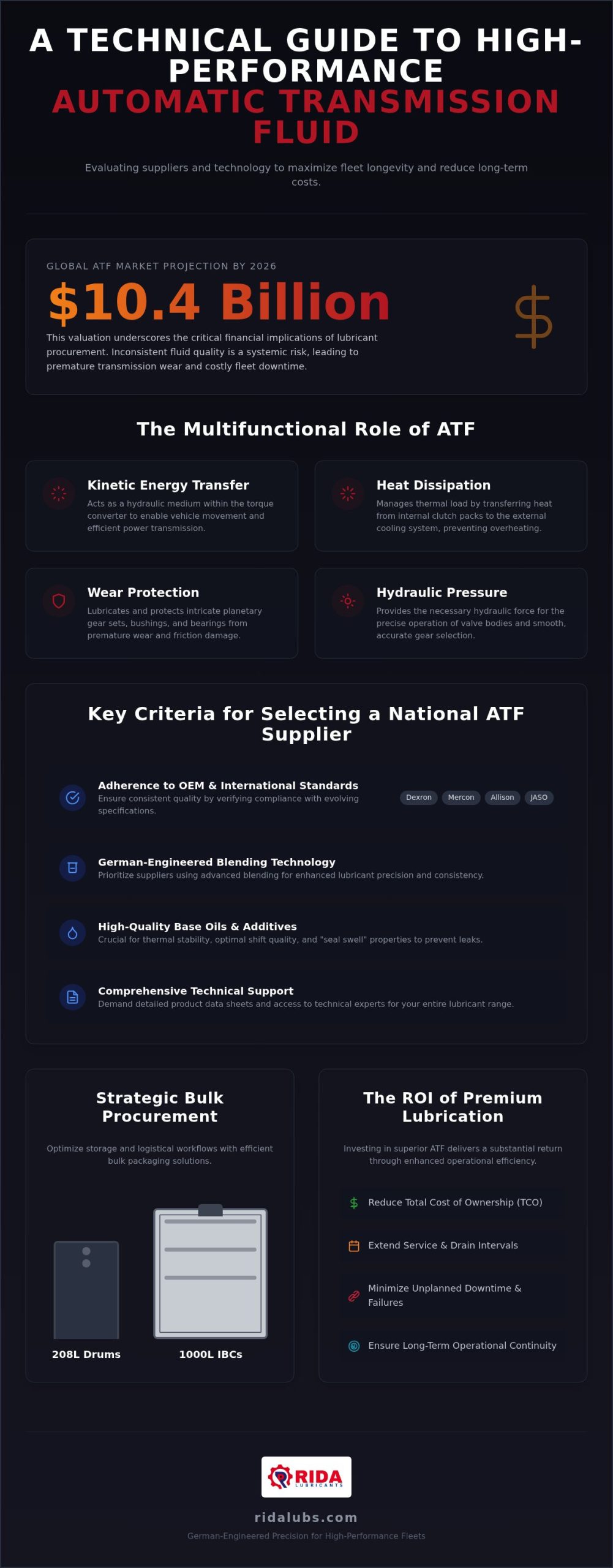
With the global transmission fluids market projected to reach a valuation of US$10.4 billion by 2026, the financial implications of lubricant procurement for industrial fleets have reached a critical threshold. Most operational leaders recognize that inconsistent fluid quality represents more than a simple maintenance hurdle; it’s a systemic risk that leads to premature transmission wear and significant disruptions in fleet uptime. You’ve likely experienced the frustration of supply chain delays or the lack of technical depth found in generic distributors. Identifying a reliable automatic transmission fluid supplier is no longer a matter of simple logistics, but a requirement for maintaining high-performance standards within the modern industrial sector.
This guide establishes a rigorous framework for the evaluation of potential partners, prioritizing the integration of German-engineered blending precision with robust national distribution capabilities. We’ll examine the methodologies required to identify a supplier utilizing advanced blending technology to ensure your fluid supply consistently adheres to Dexron and Mercon standards. This analysis provides the insights needed to reduce long-term maintenance costs through superior lubrication and secure a dependable supply chain that supports your organizational objectives.
Key Takeaways
- Understand how high-quality ATF serves as a critical multifunctional medium to prevent gear shudder and ensure efficient power transmission across heavy-duty industrial fleets.
- Identify the technical criteria for evaluating an automatic transmission fluid supplier, specifically focusing on their capacity to meet evolving Dexron, Mercon, and Allison specifications.
- Determine the most efficient bulk packaging solutions, ranging from 208L drums to 1000L IBCs, to optimize your industrial lubricant storage and logistical workflows.
- Discover how the integration of German-engineered blending technology enhances lubricant precision and significantly reduces long-term maintenance costs for large-scale operations.
- Ensure long-term operational continuity by prioritizing manufacturers that provide comprehensive technical support and detailed product data sheets for their entire lubricant range.
The Critical Role of Automatic Transmission Fluid in Fleet Longevity
As established in the technical standards for Automatic transmission fluid (ATF), this medium represents the most complex chemical formulation within a fleet’s lubrication program. It functions as a versatile hydraulic medium that must perform several disparate tasks simultaneously to ensure mechanical integrity. For a procurement manager, selecting the right automatic transmission fluid supplier is a strategic decision that directly influences the operational lifespan of high-value assets. When fluid quality diminishes, the immediate consequences often manifest as gear shudder or slippage, which are precursors to catastrophic mechanical failure.
The fluid must successfully manage several critical functions:
- Kinetic energy transfer within the torque converter to enable vehicle movement.
- Heat dissipation from the internal clutch packs to the external cooling system.
- Wear protection for intricate planetary gear sets, bushings, and bearings.
- Hydraulic pressure for the precise operation of valve bodies and gear selection.
Modern automatic transmissions are engineered with tighter tolerances and higher power densities than their predecessors. This evolution necessitates a fluid with exceptional thermal stability to withstand increased operating pressures. By investing in premium ATF, organizations can significantly reduce their total cost of ownership (TCO). While the initial purchase price might be higher than generic alternatives, the reduction in unplanned downtime and the extension of service intervals provide a substantial return on investment.
Heat Management and Thermal Oxidation
Extreme operating environments act as a catalyst for lubricant degradation. When a fluid lacks the necessary chemical resilience, it undergoes a process that creates sludge and varnish throughout the transmission’s cooling circuits and valve bodies. High-quality base oils are essential in this context; they maintain stable viscosity even when subjected to the stress of heavy-duty cycles. Thermal oxidation is the primary enemy of transmission health. Without a supplier that prioritizes advanced blending technology, fleets risk accelerated component wear and reduced cooling efficiency.
Frictional Properties and Shift Quality
The shift quality of a vehicle is determined by the precise interaction between the fluid and the clutch materials. Advanced additive packages are integrated to ensure that clutch packs engage smoothly without erratic vibrations or “hunting” for gears. It’s vital that these friction coefficients remain consistent over the entire lifespan of the fluid to prevent performance drift. Additionally, the fluid must satisfy “seal swell” requirements to ensure that internal and external seals remain pliable. A dependable automatic transmission fluid supplier provides formulations that prevent both internal pressure loss and external leaks, ensuring the transmission operates at peak efficiency from the first mile to the last.
Technical Standards: Evaluating an Automatic Transmission Fluid Supplier
Selecting a professional automatic transmission fluid supplier requires a comprehensive technical audit of their manufacturing standards and adherence to evolving international specifications. The landscape of transmission lubrication has transitioned from basic mineral-based fluids to sophisticated fully synthetic formulations that must support extended drain intervals and complex electronic controls. This shift is largely accelerated by global efficiency mandates, such as the U.S. National Highway Traffic Safety Administration’s requirement for fleets to achieve an average of 49 mpg by 2026, which necessitates the use of ultra-low-viscosity fluids to minimize internal drag. Consequently, a supplier’s ability to produce fluids that meet current standards, such as Allison TES 668 or the Japanese JASO M315:2023, is a non-negotiable benchmark for procurement excellence.
The distinction between base oil categories remains a critical factor in fleet performance. While mineral and semi-synthetic options may suffice for legacy equipment, modern industrial and commercial transmissions demand fully synthetic ATF to maintain viscosity under extreme thermal stress. A fully integrated manufacturing facility provides a distinct advantage in this sector, as it allows for total oversight of the production lifecycle, from raw material intake to the final laboratory certification of every batch. This level of integration ensures that the fluid delivered to your facility matches the technical specifications on the product data sheet without the risk of third-party contamination or dilution.
The Impact of German Blending Technology
The precision inherent in German blending technology represents the global gold standard for lubricant consistency. ATF requires an incredibly complex balance of additives, where even a minor deviation in dosing can lead to premature oxidation or seal failure. Automated blending systems eliminate the batch-to-batch variance commonly found in manual operations, providing a level of technical precision that protects high-value transmission components. Every production cycle concludes with rigorous laboratory testing to verify that the chemical properties align with the intended performance profile. For organizations seeking to strengthen their operational reliability, partnering with a manufacturer that utilizes these premium lubricant solutions ensures that every drop of fluid performs as engineered.
Deciphering OEM Specifications
Navigating the various OEM requirements is essential for maintaining equipment warranties and operational efficiency. It is vital to distinguish between multi-vehicle ATF formulations, designed for broad compatibility, and specialized high-viscosity fluids required for specific heavy-duty applications. Utilizing an outdated specification, such as an older Dexron III in a system requiring Allison TES 668, can lead to immediate mechanical degradation. A knowledgeable automatic transmission fluid supplier will provide the technical support necessary to match the correct fluid type with your specific vehicle manufacturer requirements, ensuring that your fleet benefits from the latest advancements in lubrication science while avoiding the risks associated with non-compliant fluids.
Key Criteria for Selecting a National ATF Supplier
For large-scale industrial operations, the selection of an automatic transmission fluid supplier extends beyond simple cost-per-liter metrics. It requires a thorough evaluation of a partner’s manufacturing capacity and their proven ability to fulfill substantial bulk orders without compromising chemical integrity. A supplier’s expertise is best demonstrated through a documented track record in high-heat and demanding industrial environments, where lubricant performance is tested against the most rigorous operational cycles. To ensure long-term mechanical reliability, procurement teams must prioritize partners that offer robust technical support, including the immediate availability of Product Data Sheets (PDS) that detail performance parameters under extreme stress conditions.
Compliance with international ISO and industry-specific quality standards serves as the baseline for any professional relationship in the lubricant sector. A partner that adheres to these global benchmarks provides the necessary assurance that their fluids will protect high-value assets and maintain manufacturer warranties. In an increasingly competitive market, the distinction between a generic distributor and a dedicated automatic transmission fluid supplier lies in their commitment to technical transparency and their capacity to scale production in alignment with your fleet’s growth.
Supply Chain Reliability and Lead Times
A national manufacturing presence is a critical advantage in an era of volatile global logistics. By sourcing from a local manufacturer with a fully integrated production facility, fleets can effectively bypass the delays and cost fluctuations associated with international shipping and customs clearance. It’s essential to evaluate a supplier’s stockholding capacity for high-demand fluids to ensure they can manage sudden spikes in requirements. Integrated logistics ensure that whether you require 208L drums or 1000L IBCs, the delivery schedule remains predictable, preventing the costly downtime that results from lubricant stockouts.
Quality Assurance and Certification
The designation of a lubricant as “premium” must be anchored in documented performance data rather than marketing claims. A reputable manufacturer maintains sophisticated in-house laboratories to conduct continuous testing on every production batch, ensuring that the final product adheres to strict global lubricant standards. This rigorous approach to quality assurance allows for the verification of fluid properties against the specific requirements of modern transmissions. Verification should involve reviewing the supplier’s certification history and their ability to provide batch-specific certificates of analysis, ensuring that every drop of fluid meets the high-performance standards your operation demands.
Strategic Bulk Procurement: Packaging and Logistics
Optimizing the procurement lifecycle of high-performance lubricants requires a sophisticated approach to packaging and logistical coordination. While the technical specifications of the fluid are paramount, the physical delivery and subsequent storage of these assets determine whether the theoretical performance benefits are realized in your fleet operations. A professional automatic transmission fluid supplier should offer a range of packaging configurations tailored to diverse industrial use cases, moving from 20L pails for decentralized top-up tasks to 208L drums and 1000L Intermediate Bulk Containers (IBCs) for high-volume centralized workshops. Selecting the correct volume is a strategic decision; while larger units significantly reduce the cost-per-liter and minimize packaging waste, they necessitate specific handling equipment and infrastructure to maintain safety and fluid purity.
Effective batch tracking and clear labelling are the cornerstones of a disciplined maintenance program. Every container must feature detailed information regarding the production date and batch number to ensure that the fluid utilized in high-value transmissions is within its optimal shelf life and fully traceable in the event of a technical inquiry. This level of administrative precision allows procurement managers to conduct accurate cost-benefit analyses, comparing the upfront savings of bulk purchasing against the logistical requirements of on-site storage. By aligning your volume requirements with your operational capacity, you ensure a streamlined supply chain that supports continuous uptime.
Optimising Storage and Handling
Maintaining the chemical integrity of bulk ATF requires strict adherence to environmental controls to prevent the degradation of advanced additive packages. Temperature fluctuations can lead to the formation of condensation within storage vessels, which introduces moisture—a primary contaminant that compromises the fluid’s hydraulic and frictional properties. In high-humidity environments, utilizing specialized desiccant breathers on bulk tanks is essential to prevent moisture ingress during the thermal expansion and contraction cycles of the fluid. To ensure maximum shelf life and performance, ATF should be stored in a cool, dry, and indoor environment where temperatures remain consistently between 15°C and 25°C.
Logistics for National Distribution
Coordinating multi-site deliveries for large-scale organizations demands a logistics partner capable of maintaining fluid purity throughout the entire transport chain. Specialised transport solutions are required to ensure that bulk deliveries are not exposed to cross-contamination from other industrial chemicals or environmental pollutants. Streamlining the re-ordering process is best achieved through a dedicated account manager who understands your fleet’s specific consumption patterns and can anticipate demand spikes. For organizations looking to secure a reliable and efficient supply chain, consulting with an expert automatic transmission fluid supplier provides the logistical framework necessary to support national-level operations without the risk of stockouts or delivery delays.
Rida Lubricants: Your Partner in High-Performance Transmission Solutions
Since our inception in 2017, Rida Lubricants has established a position of corporate authority as a premier automatic transmission fluid supplier, characterized by a steadfast commitment to technical excellence and industrial-grade reliability. By integrating advanced German blending technology into our fully integrated production facility, we ensure that every batch of lubricant delivers the precision required for modern, high-stress transmissions. Our operational philosophy is rooted in the belief that industrial and commercial partners deserve a level of stability that only a dedicated manufacturer can provide. We present ourselves as an authoritative expert and a visionary leader in the sector, constantly scaling our operations to meet the sophisticated demands of the automotive, marine, and industrial markets with a global perspective on lubricant innovation.
The Rida Advantage: Precision and Reliability
The Rida advantage is defined by the seamless integration of our manufacturing infrastructure, which allows for total oversight of the production lifecycle from raw material intake to final certification. Our fully integrated facility serves as a centralized hub for quality control, where we utilize automated systems to eliminate the batch-to-batch variance that often plagues the products of less sophisticated distributors. This infrastructure is specifically designed to produce fluids that maintain their chemical integrity under the extreme thermal and mechanical conditions common in heavy-duty industrial applications. By leveraging our technological investments, we deliver products that exceed international benchmarks for durability and performance. To examine the technical specifications of our full range of industrial and automotive lubricants, please visit the Rida Lubricants homepage.
Partnering for Success
We function as more than a simple vendor; we are a visionary partner dedicated to supporting distributors and fleet managers through tailored logistical solutions and comprehensive technical support. The strategic oversight provided by our international head office ensures that our formulations remain at the forefront of global industry advancements, effectively bridging the gap between national production and international excellence. This integration of regional manufacturing prowess and international standards allows us to manage complex supply chains while maintaining the highest levels of fluid purity. Our structured approach ensures that every professional partner feels informed and reassured by our transparency and systematic value proposition. We encourage professional procurement teams to contact Rida Lubricants today for bulk ATF enquiries to secure a steady supply of high-performance transmission solutions.
Securing Operational Excellence through Technical Precision
The transition toward more sophisticated, low-viscosity synthetic fluids necessitates a rigorous approach to procurement that prioritizes mechanical integrity and supply chain stability. Identifying a professional automatic transmission fluid supplier that integrates German blending technology with a fully integrated national manufacturing facility allows organizations to effectively mitigate the risks of premature component wear. This strategic alignment ensures that every batch of lubricant adheres to the highest international standards, providing the thermal stability and frictional consistency required for modern heavy-duty transmissions.
Effective fleet management relies on the seamless coordination of bulk logistics and technical support. Implementing robust storage practices and selecting the optimal packaging allows for a more disciplined maintenance program that reduces the total cost of ownership. As industrial demands continue to evolve, the necessity for a partner that offers sophisticated B2B supply chain solutions becomes increasingly paramount. We invite you to Partner with a leading automatic transmission fluid supplier and experience the reliability of precision-engineered lubrication across your entire operation. Your commitment to quality today secures the performance and longevity of your assets for the future.
Frequently Asked Questions
What are the signs that a fleet needs a higher grade of automatic transmission fluid?
Signs that a fleet requires a higher grade of automatic transmission fluid include frequent transmission overheating, erratic shifting patterns, or the presence of burnt fluid during routine inspections. In high-heat environments, lower-grade mineral fluids often fail to maintain their viscosity, leading to mechanical shuddering and slippage. Upgrading to a premium synthetic formulation ensures the fluid doesn’t fail under extreme thermal stress. This protects intricate planetary gear sets while maintaining high-performance standards.
How does German blending technology differ from standard lubricant manufacturing?
German blending technology distinguishes itself through a higher degree of technical precision in the additive dosing process. Unlike standard manufacturing, which may rely on manual batching, this automated approach ensures that every drop of fluid adheres to exact chemical specifications. This methodology minimizes batch-to-batch variance and maximizes the performance of the additive packages. At our fully integrated facility, this technology’s utilized to produce lubricants that meet the most rigorous international performance standards for industrial sectors.
Can I mix different brands of ATF if they meet the same OEM specification?
Technically, it’s possible to mix different brands of automatic transmission fluid if both products strictly adhere to the same OEM specification, such as Dexron VI or Allison TES 668. However, this practice isn’t ideal for maintaining peak performance. Different manufacturers utilize unique additive chemistries that, while compatible, may not deliver the same level of synergistic protection when combined. To ensure maximum component longevity, it’s best to maintain a consistent supply from a single automatic transmission fluid supplier.
What is the typical shelf life of automatic transmission fluid in bulk storage?
The typical shelf life for automatic transmission fluid in bulk storage ranges from three to five years, provided the containers remain sealed. Exposure to moisture or extreme temperature fluctuations can accelerate the degradation of the additive package. Maintaining fluid purity requires the use of specialized desiccant breathers on bulk tanks. It’s also vital to ensure that the seals on 208L drums or 1000L IBCs remain intact so the product doesn’t lose its protective qualities over time.
How does ATF serve as a power steering fluid in certain applications?
Automatic transmission fluid frequently serves as a power steering medium because both systems require a high-quality hydraulic fluid with excellent anti-wear and anti-foam properties. Many vehicle manufacturers specify ATF for power steering systems due to its ability to protect pumps and seals while providing consistent pressure. It’s essential to verify the specific OEM requirements, as some modern electronic power steering systems require specialized fluids that aren’t compatible with traditional transmission formulations.
What specifications should I look for in an ATF for heavy-duty marine use?
For heavy-duty marine applications, procurement managers should prioritize fluids that meet high-viscosity specifications and offer superior resistance to thermal oxidation. Marine environments place unique stresses on transmissions, requiring a fluid that can maintain its protective film under constant load while resisting high humidity. Look for formulations that demonstrate excellent water separation characteristics and adhere to standards like Allison C-4. This ensures the reliability of propulsion systems in demanding offshore conditions.
Why is viscosity index particularly important for transmissions in hot climates?
A high viscosity index is critical for transmissions operating in hot climates because it indicates the fluid’s ability to remain stable across a broad temperature spectrum. In regions where ambient temperatures are consistently high, a fluid with a low viscosity index’ll thin out excessively, leading to a loss of hydraulic pressure. Premium synthetic fluids are engineered to resist this thinning, ensuring that the transmission maintains smooth shift quality and internal component protection during peak summer operations.
How do I transition my fleet to a new automatic transmission fluid supplier?
Transitioning to a new automatic transmission fluid supplier should begin with a comprehensive technical audit of your fleet requirements. It’s professional practice to implement a phased-in approach, starting with a pilot group of vehicles to monitor performance and compatibility. A reputable supplier’ll provide detailed product data sheets and technical consultations to streamline this process. This ensures that the transition doesn’t disrupt your operations while supporting your goals of reducing maintenance costs and improving overall reliability.